Evidence & Training · Exercise Guides
How to Deadlift: Conventional and Sumo Technique
How to deadlift with conventional and sumo technique step by step, the muscles each stance emphasises according to EMG research, how to program it, and the floor and equipment a home deadlift needs.
The deadlift is the simplest of the big lifts to describe — pick a loaded bar up from the floor — and one of the most demanding to do well. It trains the whole posterior chain, the quadriceps and the grip, and it lets most lifters handle more weight than any other exercise.
This guide explains how to set up and pull with conventional and sumo stances, what research shows about the muscles each one emphasises, how often and how heavy to deadlift, and what a home setup needs so that heavy pulls do not damage your floor.
Quick answer
Stand with the bar over mid-foot, grip it just outside your legs, push your hips back until your shins touch the bar, brace, and push the floor away while keeping the bar against your legs until you stand tall.
Conventional and sumo deadlifts use largely the same muscles; sumo showed more quadriceps activity and conventional more calf activity in an EMG study [1]. One heavy session a week, at 1–6 reps with one to three reps in reserve, suits most lifters [2].
At a glance
- Movement
- Hip hinge (from the floor)
- Primary muscles
- Gluteus maximus, Hamstrings, Spinal erectors, Quadriceps
- Also works
- Adductors, Upper back and trapezius, Forearms (grip)
- Level
- Intermediate
- Equipment
- Barbells, Weight Plates, Lifting Platforms
How to do the deadlift: step by step
- 1
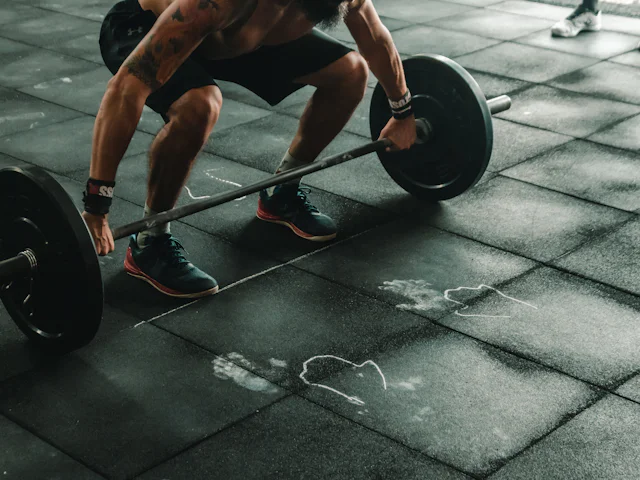
Stand with the bar over the middle of your feet — about 2–3 cm from the shins — feet hip-width apart for conventional, or wide with toes turned out for sumo.
- 2
Hinge down and grip the bar: just outside the legs for conventional, inside the legs for sumo. Use a double overhand grip until it limits you, then a mixed grip or straps.
- 3
Bend your knees until the shins touch the bar. Keep your hips higher than your knees and your shoulders slightly in front of the bar.
- 4
Pull your shoulder blades down and back (as if protecting your armpits), take a big breath and brace your trunk. Pull the slack out of the bar until you feel it tight against the plates.
- 5
Push the floor away with your legs. Keep the bar touching your legs, and let the hips and shoulders rise together.
- 6
Once the bar passes the knees, drive the hips forward to stand tall. Lower the bar by pushing the hips back first, then bending the knees once it passes them.
Muscles worked: conventional vs sumo
Moderate evidenceThe deadlift is a full-body pull. An EMG study comparing sumo and conventional deadlifts recorded activity from 16 muscles: the sumo deadlift produced greater activity in the vastus medialis, vastus lateralis and tibialis anterior, while the conventional deadlift produced greater activity in the medial gastrocnemius [1]. The two stances otherwise used the hip extensors and back muscles in similar ways.
The same study found that quadriceps, gluteus maximus, hip adductor and back muscle activity was highest in the early, more bent-knee part of the lift [1] — the break from the floor is where most of the work happens.
Compared with the Romanian deadlift, the conventional deadlift showed more rectus femoris and gluteus maximus activity and larger knee and ankle joint torques [3]. Muscle activity is not muscle growth, but it does describe which joints are doing the work.
Which stance should you use?
Limited evidenceNeither stance is universally better. Choose the one that lets you start with a flat back and the bar over mid-foot, and that you can repeat consistently. Lifters with long legs relative to their torso often find conventional more natural; those with long torsos or stiff hamstrings often prefer sumo.
Pick one stance and train it for a full training block before judging it: strength is specific to the way you train, so a stance always feels weaker at first.
How heavy and how often
Strong evidenceHeavier loads produce greater strength gains [4], but strength improves across a wide range of reps in reserve [2]. Most deadlift training therefore sits at 1–6 reps, stopped one to three reps short of failure, with maximal singles reserved for occasional tests.
Deadlifts are fatiguing, and the squat and RDL already train the same muscles, so one heavy deadlift session per week plus a lighter hinge elsewhere is common. Rest at least three minutes between heavy sets [5].
Use the plate calculator to load the bar quickly and the one-rep max calculator to estimate training weights from a recent set.
Deadlifts and your lower back
Limited evidenceDeadlifting is a recognised rehabilitation exercise. In a randomised trial in people with recurrent low back pain, an eight-week programme built on the deadlift reduced pain and increased strength, with no difference in pain intensity compared with motor control exercises; the motor control group improved more on activity and movement control [6].
Most deadlift problems come from loads that are too heavy for the lifter's current technique, or from grinding through reps once the back position has changed. Stop the set when form breaks down, not when the bar stops moving.
Variations by equipment
Sumo deadlift
Barbell + plates
Wide stance, hands inside the knees. More quadriceps and less calf activity than conventional in an EMG study [1]; often suits lifters with long torsos or limited hip-hinge mobility.
Trap bar deadlift
Trap bar + plates
The handles sit at your sides, which keeps the load closer to your body; a common choice for general strength and beginners.
Romanian deadlift
Barbell or dumbbells
Starts from the top with soft knees and focuses on the hamstrings and glutes — see the Romanian deadlift guide.
Dumbbell deadlift
Adjustable dumbbells
A practical way to learn the movement at home; loads are limited by the dumbbells.
Block or rack pull
Barbell + rack or blocks
Starts from above the floor. Useful to train the top of the lift or to deadlift with a limited range.
Equipment for the deadlift
Barbells
NeededA stiff power bar or a general 20 kg bar with good knurling. A dedicated deadlift bar is only worth it for competitive lifters.
Weight Plates
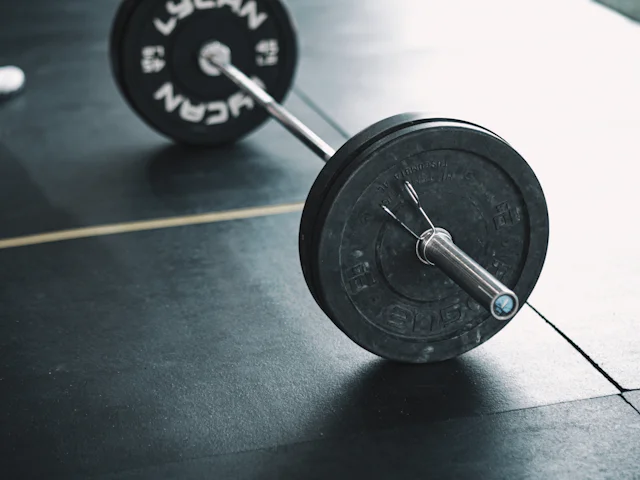
NeededFull-size 450 mm plates set the correct bar height from the floor; bumper plates are quieter and protect the floor if you drop the bar.
Lifting Platforms
NeededA platform or thick rubber tiles absorb impact and protect the floor; essential for heavy pulls in a garage or on a suspended floor.
Lifting Belts
OptionalOptional. Many lifters use a belt for their heaviest sets to help bracing.
Gym Storage
OptionalA plate tree or wall storage keeps plates off the floor and loading quick.
Common mistakes
- 1
Starting with the hips too low
Squatting the bar up pushes the knees into its path. Set the hips higher than the knees with the shoulders slightly over the bar.
- 2
Letting the bar drift away from the legs
The further the bar is from your body, the harder your back must work. Keep it in contact with the legs the whole way.
- 3
Jerking the bar off the floor
Pull the slack out of the bar first, then push the floor away. A jerk breaks your brace at the hardest point of the lift.
- 4
Training to a maximal single every week
Heavy sets with reps in reserve build the strength that a max only displays [2].
Practical takeaway
- 1Bar over mid-foot, shins to the bar, hips higher than knees, brace, push the floor away.
- 2Choose conventional or sumo based on what lets you start with a flat back.
- 3Most sets at 1–6 reps with one to three reps in reserve.
- 4One heavy session a week is enough for most lifters.
- 5Deadlift on a platform or thick rubber to protect the floor.
Conclusion
The deadlift is a straightforward lift that rewards consistent setup more than anything else. Learn one stance, keep the bar close and leave a rep or two in reserve on most sets.
At home, the floor matters as much as the bar: protect it with a platform or heavy rubber tiles, and the deadlift can be the strongest lift in your programme for years.
References
- [1]Escamilla RF, Francisco AC, Kayes AV, Speer KP, Moorman CT. An electromyographic analysis of sumo and conventional style deadlifts. Medicine & Science in Sports & Exercise. 2002;34(4):682–688. EMG study doi.org/10.1097/00005768-200204000-00019
- [2]Robinson ZP, Pelland JC, Remmert JF, et al. Exploring the Dose-Response Relationship Between Estimated Resistance Training Proximity to Failure, Strength Gain, and Muscle Hypertrophy: A Series of Meta-Regressions. Sports Medicine. 2024;54(9):2209–2231. Meta-analysis (exploratory meta-regressions) doi.org/10.1007/s40279-024-02069-2
- [3]Lee S, Schultz J, Timgren J, Staelgraeve K, Miller M, Liu Y. An electromyographic and kinetic comparison of conventional and Romanian deadlifts. Journal of Exercise Science & Fitness. 2018;16(3):87–93. EMG and kinetics study doi.org/10.1016/j.jesf.2018.08.001
- [4]Schoenfeld BJ, Grgic J, Ogborn D, Krieger JW. Strength and hypertrophy adaptations between low- vs. high-load resistance training: a systematic review and meta-analysis. Journal of Strength and Conditioning Research. 2017;31(12):3508–3523. Systematic review and meta-analysis doi.org/10.1519/JSC.0000000000002200
- [5]Grgic J, Schoenfeld BJ, Skrepnik M, Davies TB, Mikulic P. Effects of rest interval duration in resistance training on measures of muscular strength: a systematic review. Sports Medicine. 2018;48(1):137–151. Systematic review doi.org/10.1007/s40279-017-0788-x
- [6]Aasa B, Berglund L, Michaelson P, Aasa U. Individualized Low-Load Motor Control Exercises and Education Versus a High-Load Lifting Exercise and Education to Improve Activity, Pain Intensity, and Physical Performance in Patients With Low Back Pain: A Randomized Controlled Trial. Journal of Orthopaedic & Sports Physical Therapy. 2015;45(2):77–85. Randomized controlled trial doi.org/10.2519/jospt.2015.5021
This guide summarises published research for healthy adults. It is general information, not medical advice — if you have a health condition, injury or take medication, talk to a qualified professional before changing your training, diet or supplements.