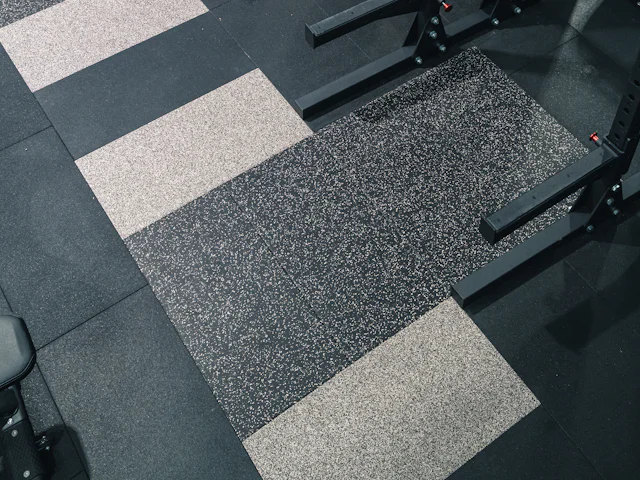
Best Overall
Fit-Lock 3/8″ Rubber Tiles
Solid interlocking rubber that installs without glue and stays put
Interlocking rubber tiles · 3/8 in · 24 × 24 in
7.9 / 10 LiftEvidence score
Gym flooring protects the floor from equipment, the equipment from the floor and your joints from hard surfaces. The right choice depends on what you lift: foam is comfortable for bodyweight work, but only dense rubber stands up to racks and barbells.
We compared eight floors sold on Amazon.com — interlocking rubber tiles, a stall mat, two rubber rolls, a rubber-top foam tile and three EVA foam mats. Specifications come from manufacturers and listings, customer notes summarise recurring review themes (including odour), and we have not tested these products.
By the LiftEvidence editorial team · Updated October 7, 2026 · 8 products compared · Affiliate disclosure
For most home gyms, the American Floor Mats Fit-Lock 3/8 in interlocking rubber tiles are the best all-round floor: solid rubber that locks together without glue and stays put. For a garage with a rack and barbell, 1/2 in stall mats give the densest, most durable surface for the money.
Rubber rolls (Rubber-Cal, IncStores) cover large rooms with fewer seams. For bodyweight training, cardio and light dumbbells, rubber-top foam (AIRHOP) or plain EVA foam (CAP, ProsourceFit) is lighter, cheaper and more comfortable.
Dense, solid rubber that will not compress under heavy equipment.
1/2″ Stall Mat 4 × 6 · Fit-Lock 3/8″ Rubber Tiles
Compare side by sideRolls and large foam packs that cover big areas with fewer seams or lower cost.
Rubber-Cal 3/8″ Roll · IncStores 1/4″ Roll · ProsourceFit ¾″ EVA
Compare side by sideLight, comfortable tiles for bodyweight work, cardio and light weights.
AIRHOP Rubber-Top Tiles · CAP ¾″ EVA Mat · ProsourceFit ½″ EVA
Compare side by sideEditorial picks for specific needs, based on the specifications and trade-offs recorded below. A label is given only where a product clearly earns it.
Best Overall
Solid interlocking rubber that installs without glue and stays put
Interlocking rubber tiles · 3/8 in · 24 × 24 in
7.9 / 10 LiftEvidence score
Best for Heavy Lifting
Dense 1/2 in rubber slabs — the garage-gym standard under racks and barbells
Rubber mats · 1/2 in · 4 × 6 ft
8.4 / 10 LiftEvidence score
Best Rubber Roll
48 sq ft of recycled-tire rubber in one roll, for fewer seams
Rubber roll · 3/8 in · 4 × 12 ft roll
7.6 / 10 LiftEvidence score
Best for Large Areas
US-made recycled rubber with a 5-year warranty for under $110 per 40 sq ft
Rubber roll · 1/4 in · 4 × 10 ft roll
6.9 / 10 LiftEvidence score
Best Rubber-Top Foam
A rubber wear layer on dense foam — easier to live with than solid rubber
Interlocking rubber tiles · 0.56 in · 24 × 24 in
7.3 / 10 LiftEvidence score
Best Large-Area Foam
96 sq ft of thick, light foam with borders, and a limited lifetime warranty
EVA foam tiles · 3/4 in · 24 × 24 in
6.6 / 10 LiftEvidence score
Best Value Foam
72 sq ft of 3/4 in foam with finished edges for about $70
EVA foam tiles · 3/4 in · 24 × 24 in
6.8 / 10 LiftEvidence score
Best Budget
The most-reviewed gym floor tile on Amazon, for about $22
EVA foam tiles · 1/2 in · 24 × 24 in
6.2 / 10 LiftEvidence score
Showing 8 of 8. Add up to 4 to a comparison.
Best Overall
Solid interlocking rubber that installs without glue and stays put
7.9
Best for Heavy Lifting
Dense 1/2 in rubber slabs — the garage-gym standard under racks and barbells
8.4
Best Rubber Roll
48 sq ft of recycled-tire rubber in one roll, for fewer seams
7.6
Best for Large Areas
US-made recycled rubber with a 5-year warranty for under $110 per 40 sq ft
6.9
Best Rubber-Top Foam
A rubber wear layer on dense foam — easier to live with than solid rubber
7.3
Best Large-Area Foam
96 sq ft of thick, light foam with borders, and a limited lifetime warranty
6.6
Best Value Foam
72 sq ft of 3/4 in foam with finished edges for about $70
6.8
Best Budget
The most-reviewed gym floor tile on Amazon, for about $22
6.2
The same criteria for every product. A dash means the information was not published or could not be confirmed. Scores are editorial assessments, not measurements.
| 8 products | Check price on Amazon → | Check price on Amazon → | Check price on Amazon → | Check price on Amazon → | Check price on Amazon → | Check price on Amazon → | Check price on Amazon → | Check price on Amazon → |
|---|---|---|---|---|---|---|---|---|
| Editorial summary (LiftEvidence) | ||||||||
| LiftEvidence score | 7.9 / 10 | 8.4 / 10 (highest) | 7.6 / 10 | 6.9 / 10 | 7.3 / 10 | 6.6 / 10 | 6.8 / 10 | 6.2 / 10 |
| Recommendation | Best Overall | Best for Heavy Lifting | Best Rubber Roll | Best for Large Areas | Best Rubber-Top Foam | Best Large-Area Foam | Best Value Foam | Best Budget |
| Best suited to | General Exercise, Garage Gym, Easy Installation | Heavy Lifting, Garage Gym, Large Areas | Large Areas, Garage Gym, General Exercise | Large Areas, Budget, General Exercise | General Exercise, Apartments & Upstairs, Easy Installation | General Exercise, Large Areas, Easy Installation | Budget, General Exercise, Easy Installation | Budget, General Exercise, Apartments & Upstairs |
| Impact protection | Good | Excellent | Good | Moderate | Good | Moderate | Moderate | Limited |
| Specifications (manufacturer) | ||||||||
| Type | Interlocking rubber tiles | Rubber mats | Rubber roll | Rubber roll | Interlocking rubber tiles | EVA foam tiles | EVA foam tiles | EVA foam tiles |
| Thickness | 3/8 in | 1/2 in | 3/8 in | 1/4 in | 0.56 in | 3/4 in | 3/4 in | 1/2 in |
| Piece size | 24 × 24 in | 4 × 6 ft | 4 × 12 ft roll | 4 × 10 ft roll | 24 × 24 in | 24 × 24 in | 24 × 24 in | 24 × 24 in |
| Coverage per purchase | 16 sq ft (4 tiles) | 24 sq ft per mat | 48 sq ft | 40 sq ft | 48 sq ft (12 tiles) | 96 sq ft (24 tiles + 12 borders) | 72 sq ft (18 tiles) | 24 sq ft (6 tiles) |
| Material | Rubber | Rubber (made in the US) | Recycled tire rubber | Recycled rubber (made in the US) | Rubber top layer, high-density EVA foam base | High-density EVA foam | High-density EVA foam | High-density EVA foam |
| Interlocking | Yes | No | No | No | Yes | Yes | Yes | Yes |
| Surface | Textured rubber | Solid rubber | Textured rubber | Rubber | Textured rubber | Weave-texture foam | T-pattern texture | Textured foam |
| Piece weight | Not reliably published | Not reliably published | Not reliably published | Not reliably published | About 2.4 lb per tile (29 lb total, listing) | Not reliably published | About 1.2 lb per tile (21.5 lb total, listing) | Not reliably published |
| Warranty | — | — | — | 5 years (listing). | — | Limited lifetime warranty (listing). | — | Limited lifetime warranty (listing). |
| Price & customer ratings (Amazon) | ||||||||
| Price band | Mid-range | Mid-range | Mid-range | Budget | Budget | Mid-range | Budget | Budget |
| Amazon customer rating | 4.7/5 (1,286 ratings) | 4.5/5 (448 ratings) | 4.4/5 (334 ratings) | 4.3/5 (929 ratings) | 4.6/5 (1,806 ratings) | 4.6/5 (7,103 ratings) | 4.6/5 (377 ratings) | 4.6/5 (60,960 ratings) |
| Editorial assessment (LiftEvidence) | ||||||||
| Less suitable for | Repeated heavy barbell drops — add a platform or drop pads. | Carpeted or upstairs rooms where moving heavy mats is impractical. | Odour-sensitive spaces without good ventilation. | Barbell drops or heavy deadlifts. | Heavy barbell lifting and drops, or heavy machines that will dent foam. | Racks, barbells or heavy machines. | Racks, barbells and heavy machines. | Any heavy equipment or lifting. |
| Strengths |
|
|
|
|
|
|
|
|
| Drawbacks |
|
|
|
|
|
|
|
|
| Impact protection score | 7.5 / 10 | 9.0 / 10 (highest) | 7.5 / 10 | 5.5 / 10 | 6.5 / 10 | 5.5 / 10 | 5.5 / 10 | 4.0 / 10 |
| Durability score | 8.5 / 10 | 9.5 / 10 (highest) | 8.5 / 10 | 8.0 / 10 | 7.0 / 10 | 6.0 / 10 | 6.5 / 10 | 5.5 / 10 |
| Lifting suitability score | 8.0 / 10 | 9.0 / 10 (highest) | 8.0 / 10 | 6.0 / 10 | 6.0 / 10 | 3.5 / 10 | 3.5 / 10 | 3.0 / 10 |
| Installation & fit score | 9.0 / 10 | 6.0 / 10 | 7.0 / 10 | 7.0 / 10 | 9.0 / 10 | 9.5 / 10 (highest) | 9.5 / 10 (highest) | 9.5 / 10 (highest) |
| Odour & cleaning score | 7.0 / 10 | 6.5 / 10 | 6.5 / 10 | 6.5 / 10 | 8.0 / 10 | 8.5 / 10 (highest) | 8.5 / 10 (highest) | 8.5 / 10 (highest) |
| Value score | 7.5 / 10 | 8.0 / 10 | 7.5 / 10 | 8.5 / 10 | 8.5 / 10 | 8.5 / 10 | 9.0 / 10 (highest) | 9.0 / 10 (highest) |
What matters most
Rubber for weights, foam for comfort
Solid rubber is firm and durable under racks, barbells and heavy machines. EVA foam is comfortable and cheap but compresses and marks under weight.
Thickness
1/4 in protects floors under cardio machines; 3/8–1/2 in suits general lifting; 3/4 in or more, plus a platform or pads, for dropped weight.
Tiles, mats or rolls
Interlocking tiles are easiest to lay and move; stall mats are cheapest per square foot for dense rubber; rolls cover large areas with fewer seams.
Odour
Recycled rubber often smells at first. Airing it out and washing it helps; owner reports vary widely.
Coverage and cost
Compare price per square foot — and remember borders and edges if you want a finished look.
Solid rubber is dense and firm: it spreads the load of racks and barbells, resists cuts and dents, and lasts for many years. EVA foam is soft and light: comfortable for floor work and cheap, but it compresses, marks and tears under heavy equipment. Rubber-top foam sits in between.
If you lift with a barbell, choose rubber at least under the lifting area.
Related: Fit-Lock 3/8″ Rubber Tiles · CAP ¾″ EVA Mat
Around 1/4 in is enough under cardio machines and benches. 3/8–1/2 in suits general strength training and dumbbells. For dropped barbells, add a lifting platform or drop pads — flooring alone is not designed for repeated drops.
Interlocking tiles are easiest to install, extend and take with you when you move. Stall mats (4 × 6 ft) are the cheapest dense rubber per square foot but heavy to handle. Rolls minimise seams across a room but need careful measuring and cutting.
Related: 1/2″ Stall Mat 4 × 6 · Rubber-Cal 3/8″ Roll
Recycled rubber commonly smells when new; reports range from none to very strong on the same product. Unroll or lay it out somewhere ventilated for several days, wash it with mild soap and water, and expect the smell to fade over weeks. Laminated and foam surfaces smell less.
Lay rubber on a clean, dry, level floor. Use a sharp utility knife and a straight edge, scoring several times rather than cutting in one pass. Double-sided tape keeps rolls and mats from shifting; interlocking tiles usually need nothing.
Compare cost per square foot rather than per box. Foam is usually the cheapest; stall mats are the cheapest dense rubber; branded interlocking rubber costs more but is easier to fit and move.
We shortlisted flooring available on Amazon.com and compared each product on impact protection (25%), durability (20%), lifting suitability (15%), installation and fit (10%), odour and cleaning (10%) and value (20%).
Specifications come from manufacturers and Amazon listings. Where ratings are shared across sizes or colours, we say so. Odour is reported from owner reviews and varies widely. We have not tested these products.
For lifting, solid rubber — interlocking tiles, stall mats or rolls. For bodyweight workouts, yoga and cardio, EVA or rubber-top foam is cheaper and more comfortable.
It is not recommended. Foam compresses under the rack’s feet and loaded barbells, making the rack less stable and marking the tiles. Use dense rubber under racks.
Air the rubber out in a ventilated space for several days, wash it with mild soap and water, and keep the room ventilated. The smell usually fades over a few weeks.
Concrete is durable but hard on equipment, plates and joints, and cold. Rubber flooring protects all three and makes a garage much more usable as a gym.
Product specifications come from manufacturers and their Amazon.com listings (each product page lists its sources); customer themes come from Amazon reviews and are reported as user experience, not as evidence. Ratings and review counts were checked on October 7, 2026. LiftEvidence scores are editorial assessments; we have not tested these products ourselves. First published October 7, 2026.